
Hello everybody, and welcome to this week’s analysis of the S&P 500. We had another quite volatile week. Looking at the 4-hour chart, we can see that the index finished the week down about 0.2%, so overall it did not go anywhere. However, volatility was very high.
On Monday, the market made a low and then rallied strongly into Tuesday. I marked this move on the 4-hour chart. After that, we saw a sharp drop into the end of the week, with prices falling almost 4% at the low, which can be described as a short-term crash. On Friday, however, we saw a very strong recovery. From the trough to the high of the day, prices rebounded by roughly 3%, which helped stabilize the weekly close and brought the index close to where it started the week.
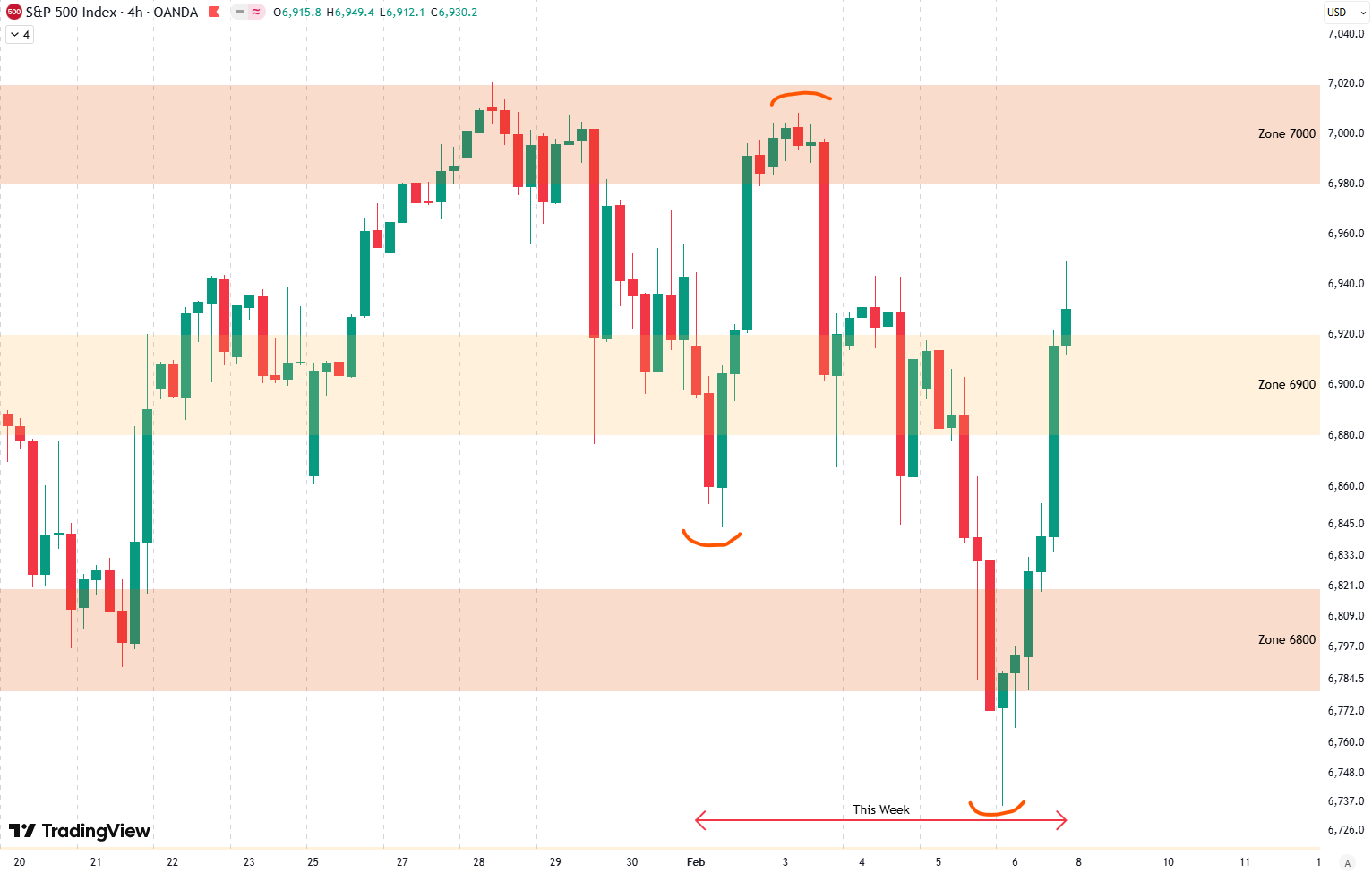
You can also see on the chart that the zone around 7,000 points once again acted as important resistance. This level marked the top of the move earlier in the week and is highlighted on the chart. On the downside, the 6,800-point area proved to be an important support zone, also marked on the chart.
Are you wondering when to buy the S&P 500 as an investor? Join our community of smart do-it-yourself investors who are making informed decisions with our expert insights, just by signing up with your email!
Premium Guide
Advanced Investing Signals
Basic Guide
Basic Investing
Signals
Simple Guide
Selected
Signals
Get started today with our free financial guide! Just enter your email, and you’ll start receiving our most popular Simple Guide with exclusive market signals right in your inbox.
Sharp Midweek Sell-Off Followed by a Strong Friday Rebound
Now let’s look at the daily chart from last week’s newsletter, where I highlighted the key support and resistance levels for this week. As you can see, I marked the 7,000-point zone and the 6,800-point zone with red lines, and these levels played out almost perfectly.
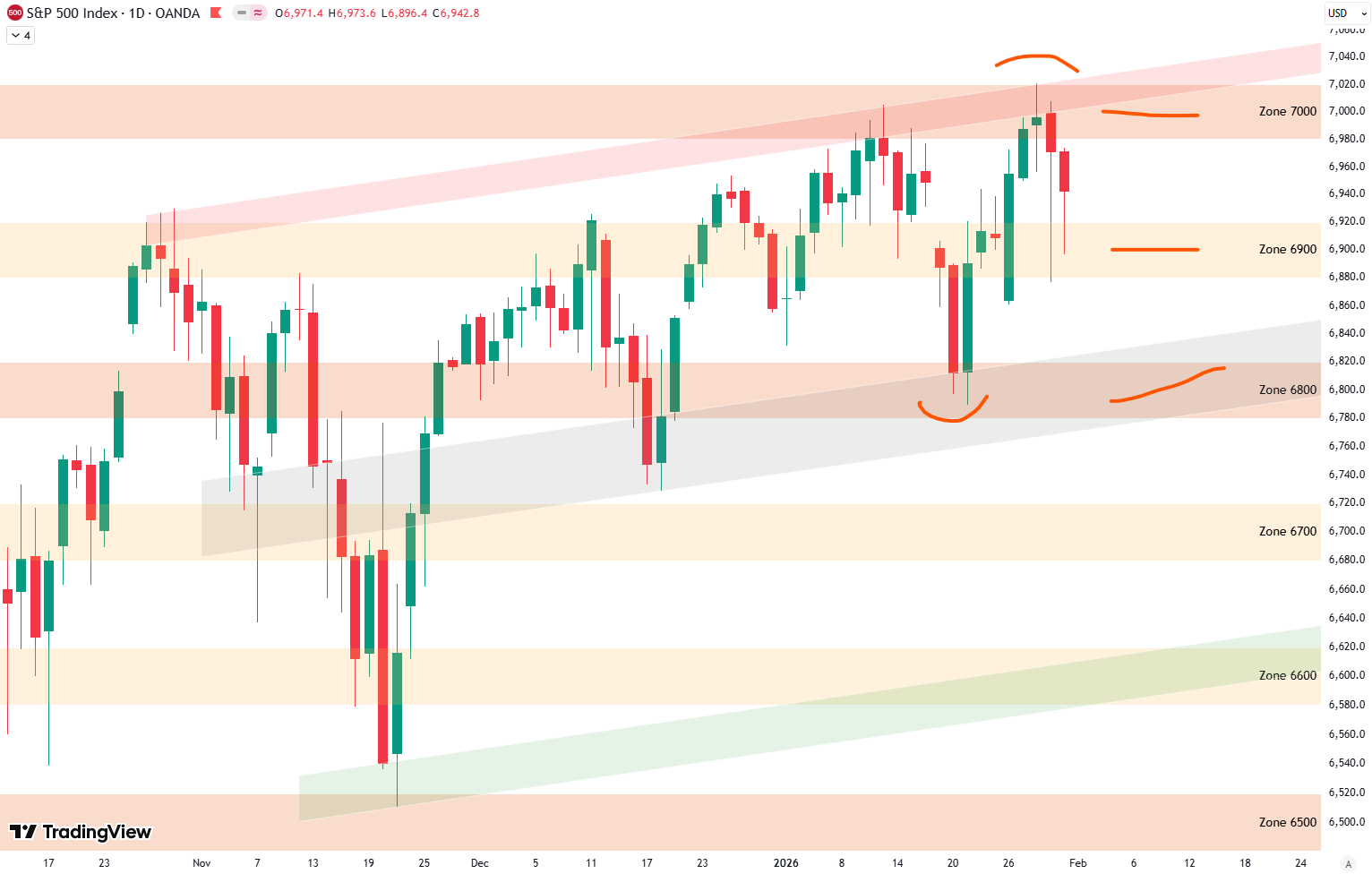
When we look at the updated daily chart with this week’s price action, we first see the top early in the week, where price touched the red shaded area. This area represents the upper resistance line of the trend channel and aligns with the 7,000-point resistance zone. Price was rejected there and then moved sharply to the downside, all the way to the 6,800-point area.

That 6,800-point level provided support and also lined up with the gray shaded area, which represents the middle trend line of our trend channel. From there, we saw the strong bullish candle on Friday, with price pushing back above the 6,900-point level and effectively stabilizing this week’s price action.
Based on this recovery, we can expect a continuation of the move to the upside, at least toward the 7,000-point zone again. It is also possible that we see a marginal new all-time high, but we will have to see how price behaves next week.
I also marked the two most important zones for the upcoming week with red lines. On the upside, the 7,000-point zone remains the key resistance level. On the downside, the gray shaded area, which is the middle trend line of the trend channel around 6,800 points, remains the most important support. These are the two key ranges to watch, and price will likely continue to oscillate between them, as it has done over the past few weeks.
Risk Outlook
Finally, let’s look at our risk outlook. Here you can see the short-term risk indicator, with the S&P 500 shown in black on the bottom, the buy score in green, and the sell score in red. On the top right, you have a zoomed-in view of the recent price action, and on the top left, you can see the buy and sell signals generated by this indicator.
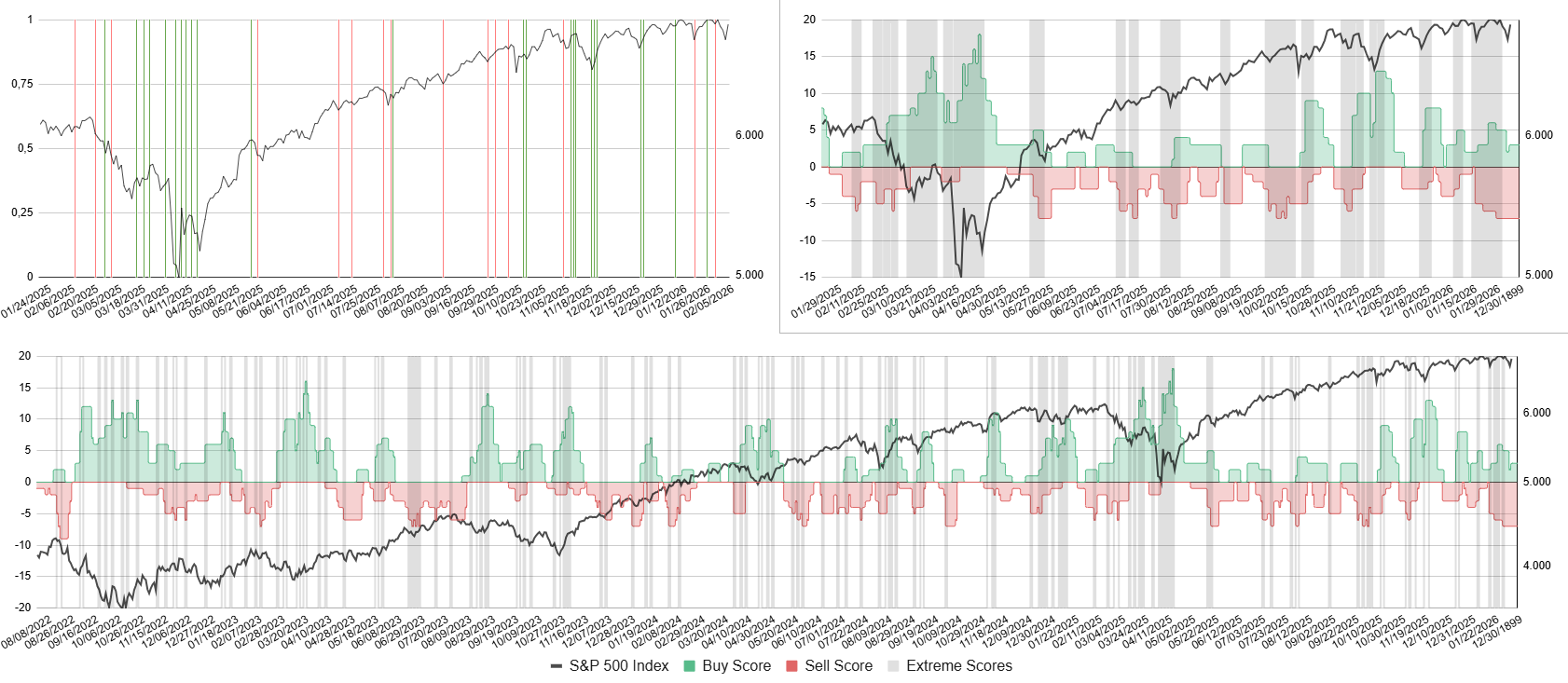
On the top-right chart, you can see that the sell score had been increasing while the buy score was decreasing. We already had the last sell signal at the end of the previous week. This week, no new signal was triggered, but it is quite possible that we will see another buy or sell signal in the coming week, depending on how market internals evolve. At the moment, we are positioned at three out of four in terms of exposure.
If you are interested in receiving these buy and sell signals, you can sign up for our free newsletter, where we distribute them on a daily basis according to this indicator.
Lastly, let’s also look at the mid-term risk outlook. On the bottom chart, you can see the S&P 500 going back to 2017, with white, gray, yellow, and red shaded areas indicating different risk environments. For now, we are still in the low-risk environment, shown by the gray shaded area, which has been in place since around October or November.
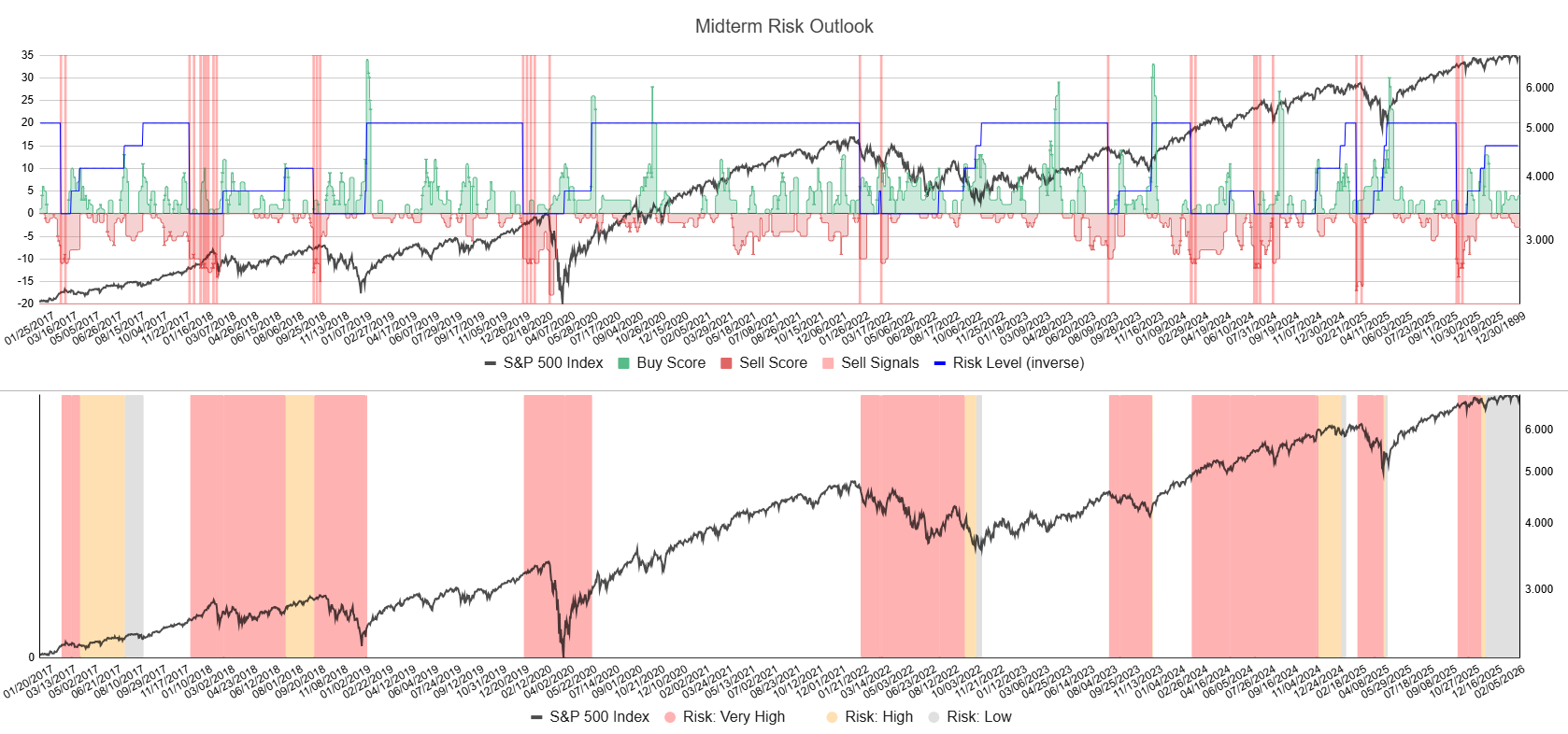
This week, however, we came very close to triggering an important sell signal on this mid-term indicator. Without the strong price action on Friday, that signal would likely have been triggered and would have moved the model into a high-risk environment, shown in red. For now, everything remains constructive, and we will continue to track this closely in our weekly newsletter and see how things develop in the coming week.
We also have an article (Update: January 20, 2026) on the broader S&P 500 outlook. From a big-picture perspective, the technicals on the weekly chart are less positive and suggest that another correction could be developing in the coming weeks.
For subscribers it is very important to follow our risk management measures that we provide with all our services to protect against losses in case support zones break
Stay ahead of the market! Sign up for our weekly updates and get additional expert insights on the S&P 500, key support levels, and market trends.
S&P 500: Seasonality Insights for 2026
When we look at the seasonality of the S&P 500, the last quarter of 2025 did not line up very well with the typical seasonal pattern. That’s not a problem, though — seasonality should be seen more like a weather model. It gives us a possible direction the market could take, not a precise forecast.
We did see weakness in October, which actually matched the seasonal pattern, as seasonality often points to a softer October. However, we did not get the strong year-end rally that seasonality would normally suggest.
Looking ahead to the first quarter of 2026, the seasonal pattern points to potential weakness in January, followed by rising prices in February, with a possible peak during that month. After that, seasonality suggests renewed weakness into March to start the year. We’ll have to see whether the market follows this pattern.

Seasonality isn’t a perfect roadmap — it rarely plays out exactly the same way each year. But it does offer useful context. Right now, it suggests that while the broader trend remains positive into year-end, a short-term correction could still unfold before the next strong push higher into December.
Of course, this isn’t a guarantee — it’s more of a roadmap based on past patterns. Ultimately, seasonal trends provide valuable context, but they must be considered alongside current market dynamics and technical analysis for a clearer picture.
Track Market Risk with Our Dashboard
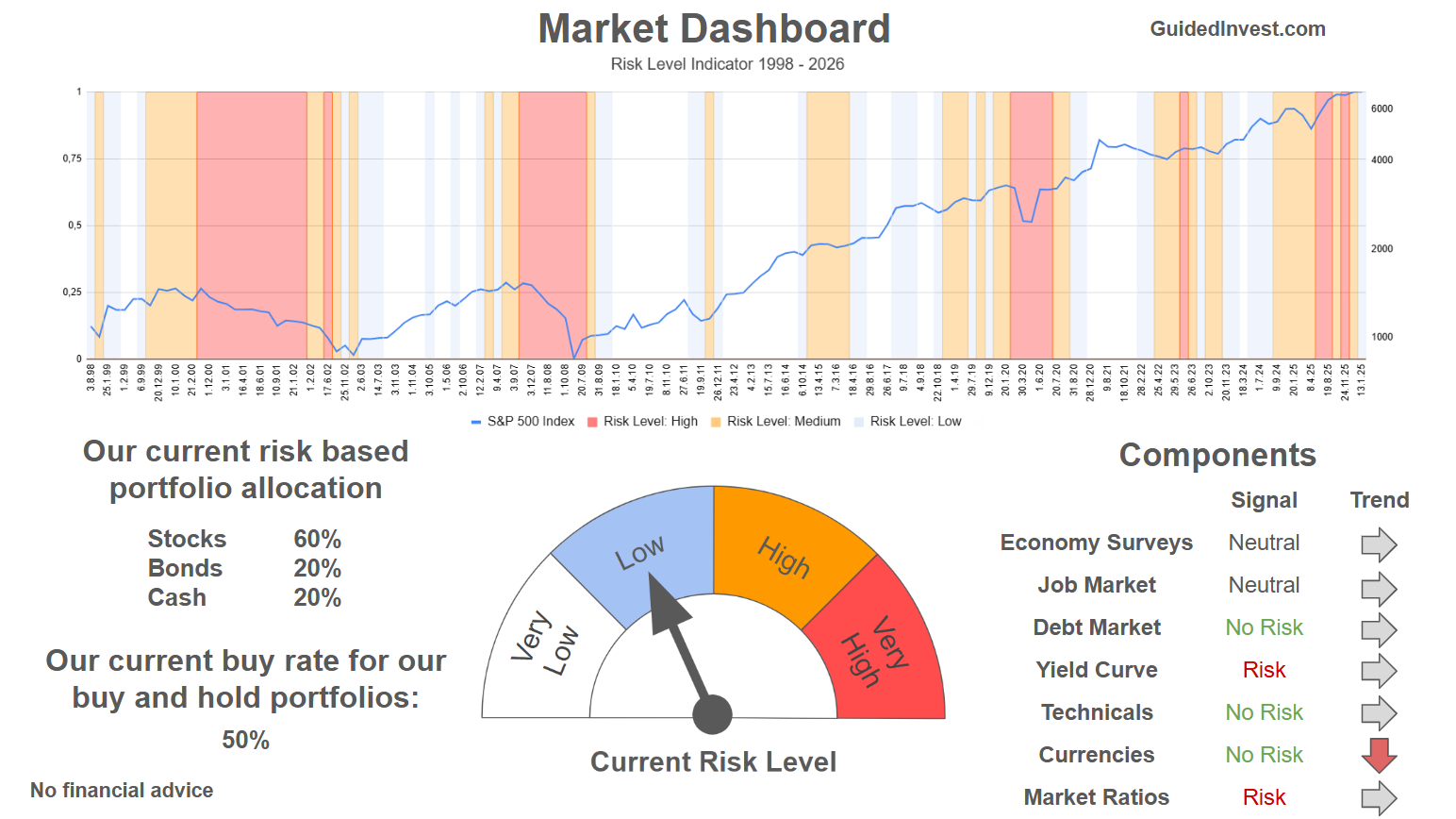
Our Market Dashboard provides a quick overview of the current market conditions and, more importantly, the associated risk. You can view a chart of one of our tools, the Risk Level Indicator, showing predicted risk from 1998 to 2025. If you are interested, you can visit our Dashboard site here.
The world of finance is complex and includes many technical terms. For explanations of these terms, I recommend using the Investopedia dictionary.
Leave a Reply